
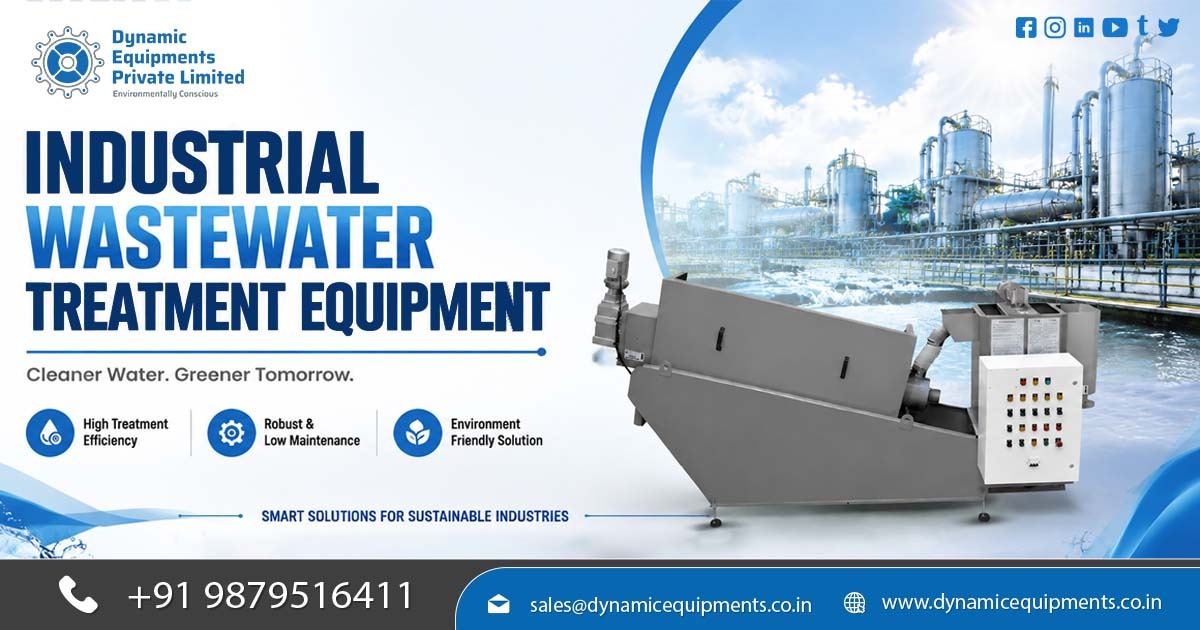
Industrial wastewater treatment produces large volumes of sludge containing water, suspended solids, chemicals and process residues. Managing this sludge without an efficient dewatering system can increase disposal costs, consume valuable storage space and create operational challenges.
Industrial sludge dewatering equipment provides a practical solution by separating excess water from sludge and converting it into a compact, manageable cake.
Dynamic Equipments Private Limited offers sludge dewatering solutions designed to support efficient wastewater management across diverse industrial applications.
We are based in Ahmedabad, Gujarat, India.
Why Sludge Dewatering Matters to Modern Industries
Untreated or poorly dewatered sludge can become a major operational burden. Its high water content increases its weight, volume and disposal cost. A properly selected dewatering system can help industries achieve several important objectives.
1. Significant Sludge-Volume Reduction
Removing excess water produces a smaller quantity of concentrated sludge cake. This helps reduce the space required for temporary storage and simplifies material handling.
2. Lower Transportation Costs
Transporting water-rich sludge is expensive. Dewatering reduces the overall weight and volume of the waste, which may decrease the number of disposal trips required.
3. Improved Plant Cleanliness
Controlled dewatering minimises uncontrolled sludge accumulation, leakage and spillage. It supports a cleaner working environment and more systematic plant operation.
4. Easier Sludge Handling
Dewatered cake is generally easier to collect, transfer, store and load than liquid sludge. Depending on its composition and applicable regulations, facilities may send the dewatered sludge for further treatment, authorised disposal, or beneficial reuse.
5. Better Wastewater-Treatment Efficiency
Effective sludge removal prevents excessive solids from circulating within the treatment system. This can support stable operation of clarifiers, biological processes and downstream equipment.
6. Support for Environmental Compliance
A structured sludge-management process helps industrial facilities follow applicable wastewater, waste-handling and disposal requirements.
How Industrial Sludge Dewatering Equipment Works
Although the exact process depends on the selected technology, a typical sludge dewatering operation includes the following stages:
- Sludge is collected from a clarifier, thickener, settling tank or treatment unit.
- The sludge may be conditioned using a suitable polymer or coagulant.
- Conditioned sludge is fed into the dewatering equipment.
- Mechanical pressure, filtration or centrifugal force separates water from the solids.
- Separated liquid is collected for treatment or recirculation.
- Dewatered sludge cake is discharged for storage, transportation or further processing.
Industries That Benefit from Sludge Dewatering
Industrial sludge dewatering equipment can be used in numerous sectors, including:
- Chemical and process industries
- Pharmaceutical manufacturing
- Food and beverage processing
- Textile and dyeing plants
- Pulp and paper mills
- Paint, pigment and coating industries
- Metal finishing and electroplating units
- Mining and mineral processing
- Tanneries and leather-processing facilities
- Oil and gas operations
- Municipal and industrial wastewater-treatment plants
- Common and captive effluent-treatment facilities
Frequently Asked Questions
Q1: What is the main purpose of sludge dewatering equipment?
Its primary purpose is to separate excess water from sludge, reducing its volume and producing a more manageable sludge cake.
Q2: Which dewatering equipment is best for industrial sludge?
The best option depends on sludge type, feed concentration, required capacity, desired cake dryness, available space and operating preferences.
Q3: Can dewatered water be reused?
The separated liquid may be returned to the treatment process or considered for reuse after suitable treatment and quality verification.
Q4: Does sludge dewatering reduce disposal costs?
It can reduce transportation and disposal requirements by lowering the weight and volume of sludge. Actual savings depend on sludge characteristics and local disposal arrangements.
Q5: Is polymer dosing always necessary?
Not always, but many sludge types benefit from chemical conditioning. Laboratory testing or pilot trials can help determine the correct chemical and dosage.
Industrial Sludge Dewatering Equipment Supplier in Uttar Pradesh
We supply Industrial Sludge Dewatering Equipment in Uttar Pradesh, including the following locations: Kanpur, Lucknow, Ghaziabad, Agra, Meerut, Varanasi, Prayagraj, Bareilly, Aligarh, Moradabad, Saharanpur, Gorakhpur, Noida, Firozabad, Jhansi, Muzaffarnagar, Mathura-Vrindavan, Ayodhya, Rampur, Shahjahanpur, Farrukhabad-Fatehgarh, Budaun, Maunath Bhanjan, Hapur, Etawah, Mirzapur-Vindhyachal, Bulandshahr, Sambhal, Amroha, Hardoi, Fatehpur, Raebareli, Orai, Sitapur, Bahraich, Modinagar, Unnao, Jaunpur, Lakhimpur, Hathras, Banda, Pilibhit, Barabanki, Khurja, Gonda, Mainpuri, Lalitpur, Etah, Deoria, Ghazipur, Sultanpur, Azamgarh, Bijnor, Sahaswan, Basti, Chandausi, Akbarpur, Ballia, Tanda, Greater Noida, Shikohabad, Shamli, Awagarh and Kasganj.
Contact Dynamic Equipments Private Limited
Contact Dynamic Equipments Private Limited today for efficient industrial sludge dewatering equipment tailored to your treatment requirements.
Website: www.dynamicequipments.co.in
Phone: +91 98795 16411
Email: [email protected]