
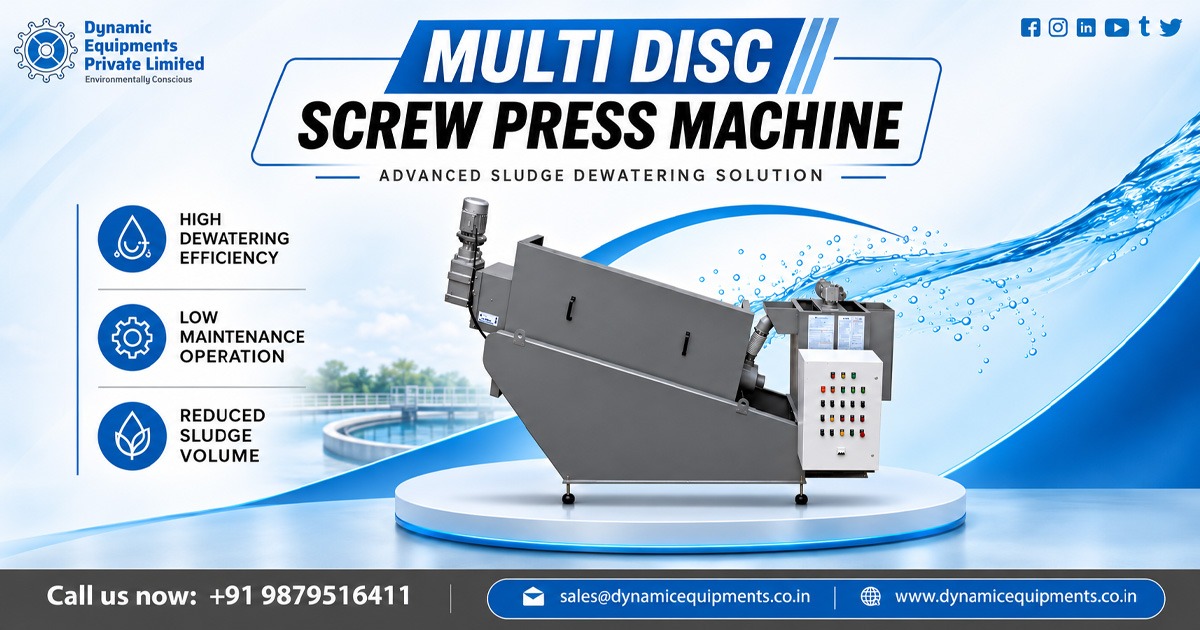
A sludge dewatering machine for wastewater treatment plants (STP & ETP) helps industries and municipal facilities reduce sludge moisture, minimize waste volume, lower disposal costs, and improve wastewater management efficiency.
Dynamic Equipments Private Limited provides sludge dewatering solutions designed to separate water from sludge and support continuous, reliable operation across industrial and sewage treatment applications.
In wastewater treatment plants, sludge often contains a high percentage of water, making its handling, transportation, storage, and disposal expensive. A sludge dewatering machine removes excess water from the sludge, producing a more concentrated solid cake and separated liquid that can be managed through the appropriate treatment process.
Dynamic Equipments Private Limited offers sludge dewatering equipment for wastewater treatment applications where efficient solids separation, reduced sludge volume, operational reliability, and cost-effective waste management are important.
Sludge Dewatering Machine
A sludge dewatering machine is industrial equipment used to remove excess water from sludge generated during sewage treatment, effluent treatment, and industrial wastewater processing.
Our machine separates liquid from solid particles using mechanical pressure, filtration, or other dewatering mechanisms.
The process reduces the sludge volume and produces dewatered sludge cake, making downstream handling and disposal more manageable.
Sludge dewatering is an important stage in:
- Sewage Treatment Plants (STP)
- Effluent Treatment Plants (ETP)
- Industrial wastewater treatment facilities
- Chemical and pharmaceutical industries
- Food and beverage processing plants
- Textile and dyeing industries
- Paper and pulp manufacturing facilities
- Municipal wastewater treatment plants
How Does a Sludge Dewatering Machine Work?
A sludge dewatering machine separates water from sludge through a controlled mechanical process. Depending on the machine design, the process may involve filtration, compression, screw movement, or pressure-based separation.
1. Sludge Feeding
The treatment plant transfers sludge from the sludge collection tank or thickening system into the dewatering machine through a controlled feed arrangement.
2. Conditioning and Flocculation
Operators may add polymer or other conditioning chemicals to improve the formation of flocs. These flocs help bind fine suspended solids together and improve separation efficiency.
3. Mechanical Dewatering
The machine applies mechanical pressure or filtration to separate water from the sludge. The dewatering mechanism allows water to pass through the filtration system while retaining solids.
4. Filtrate Collection
The separated water, known as filtrate or centrate depending on the equipment design, flows into a collection system for further treatment, reuse, or return to the plant process.
5. Sludge Cake Discharge
The dewatered sludge exits the machine in a more concentrated form, reducing its volume and making it easier to transport, store, and dispose of.
Applications of Sludge Dewatering Machines in STP and ETP Plants
Dynamic Equipments Private Limited’s sludge dewatering solutions are suitable for a range of wastewater treatment applications where sludge volume reduction and solids separation are essential.
| Application | Sludge Source |
| Municipal STP | Sewage sludge, biological sludge and activated sludge |
| Industrial ETP | Process wastewater and treatment sludge |
| Textile industry | Dyeing, washing and textile processing sludge |
| Food industry | Organic wastewater treatment sludge |
| Pharmaceutical industry | Process and biological treatment sludge |
| Chemical industry | Chemical precipitation and treatment residues |
| Paper industry | Fibre-rich and process wastewater sludge |
| Manufacturing plants | Oil-containing, suspended and process-generated sludge |
Frequently Asked Questions
Q1: How does a sludge dewatering machine reduce sludge disposal costs?
A1: It separates water from sludge, reducing the volume of material requiring transportation and disposal. Actual cost savings depend on sludge characteristics, dewatering performance, and disposal rates.
Q2: Which sludge dewatering machine is suitable for wastewater treatment plants?
A2: Screw presses, belt filter presses, and filter presses are commonly used. The suitable type depends on sludge properties, feed capacity, desired cake dryness, available space, and operating conditions.
Q3: Can a sludge dewatering machine be used for both STP and ETP applications?
A3: Yes. Sludge dewatering equipment can be used in both sewage treatment and industrial effluent treatment plants, provided the equipment is selected according to sludge characteristics and process requirements.
We Supply Sludge Dewatering Machine for Wastewater Treatment Plants STP ETP in India including locations Andhra Pradesh, Arunachal Pradesh, Assam, Bihar, Chandigarh, Chhattisgarh, Dadra and Nagar Haveli and Daman and Diu, Delhi, Goa, Gujarat, Haryana, Himachal Pradesh, Jammu and Kashmir, Jharkhand, Karnataka, Kerala, Ladakh, Madhya Pradesh, Maharashtra, Manipur, Meghalaya, Nagaland, Odisha, Puducherry, Punjab, Rajasthan, Sikkim, Tamil Nadu, Telangana, Tripura, Uttar Pradesh, Uttarakhand, West Bengal.
Reduce sludge volume. Improve handling. Optimize your wastewater treatment process with Dynamic Equipments Private Limited.
Website: www.dynamicequipments.co.in
Phone: +91 98795 16411
Email: [email protected]
View Product: Click here